 FazeCT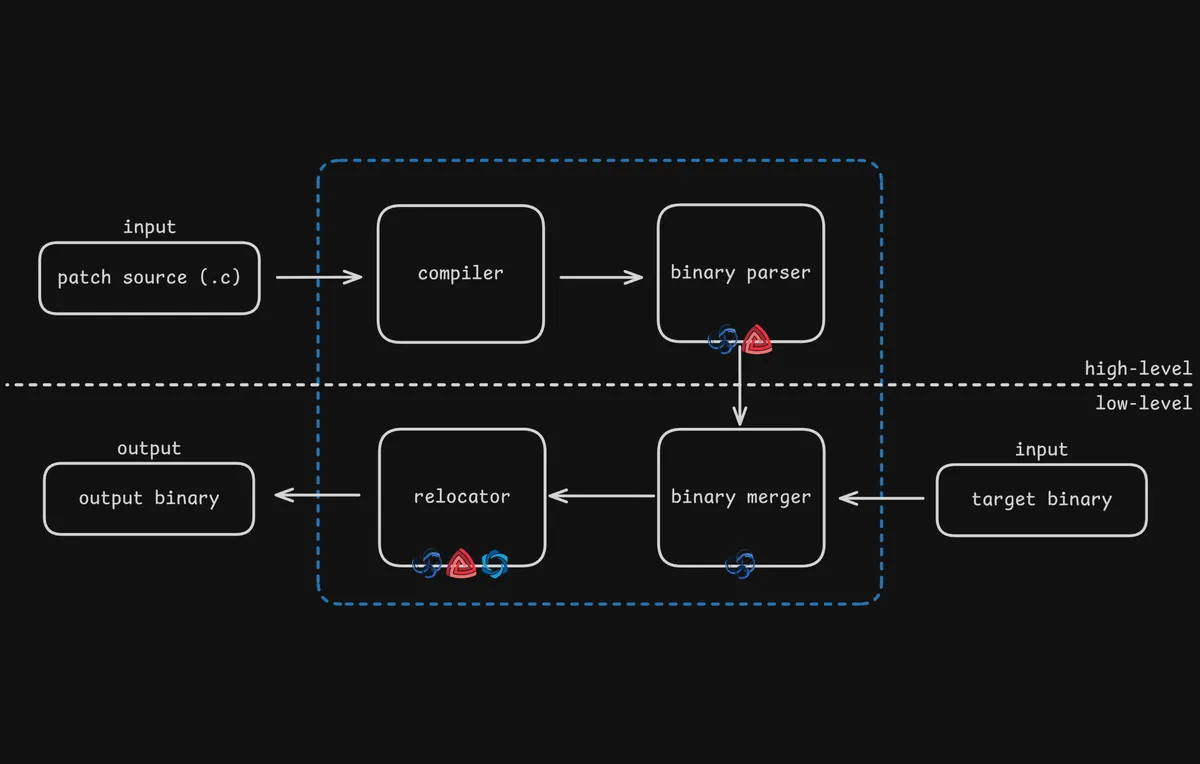
Introduction
This work introduces 1-patch, a static binary patcher that demonstrates the usage of patches written in high-level programming languages in patching binaries. Currently, it supports C, and works with patching x86-64 ELF binaries.
Methodology
Normally, binary patches are made by either inline replacing with new code, or binary lifting to insert new instructions. This work aims to leverage a technique called code insertion/injection to insert user-written C code into the binary.
For a new item (global variable/function) to be added to the binary, sufficient regions in the binary are needed to contain them. Merging happens between components such as relocation table and GOT/PLT between the original code and the integrated code. New sections and segments could be created just in case.
To completely replace a global variable or a function, every reference that points to the original element must be diverted to point to the new definition. The tool operates a linear scan to detect all read/write reference (in case of a global variable) and all call/jmp instructions (in case of a function).
The tool also attempts to place a trampoline jmp (if possible) in place of the original function to redirect the flow to the fixed function. This is solely utilized for catching indirect calls that we cannot scan for.
Then why don’t we just install a trampoline and ignore the references change? That is because, the rely-on-trampoline solution is not guaranteed to be always applicable. For instance, an n-byte jmp cannot be installed properly if the length of the original code
is smaller than n - as an example, a ret stub function.
The trampoline insertion also skips over endbr64 to retain the usability of CET in a binary, if the protection exists. And since endbr64 is treated as a nop in a non-CET binary, -fcf-protection=full is safely enabled by default when compiling C patches.
Consider the following case where the main() function at 0x11C6 needs to be replaced:
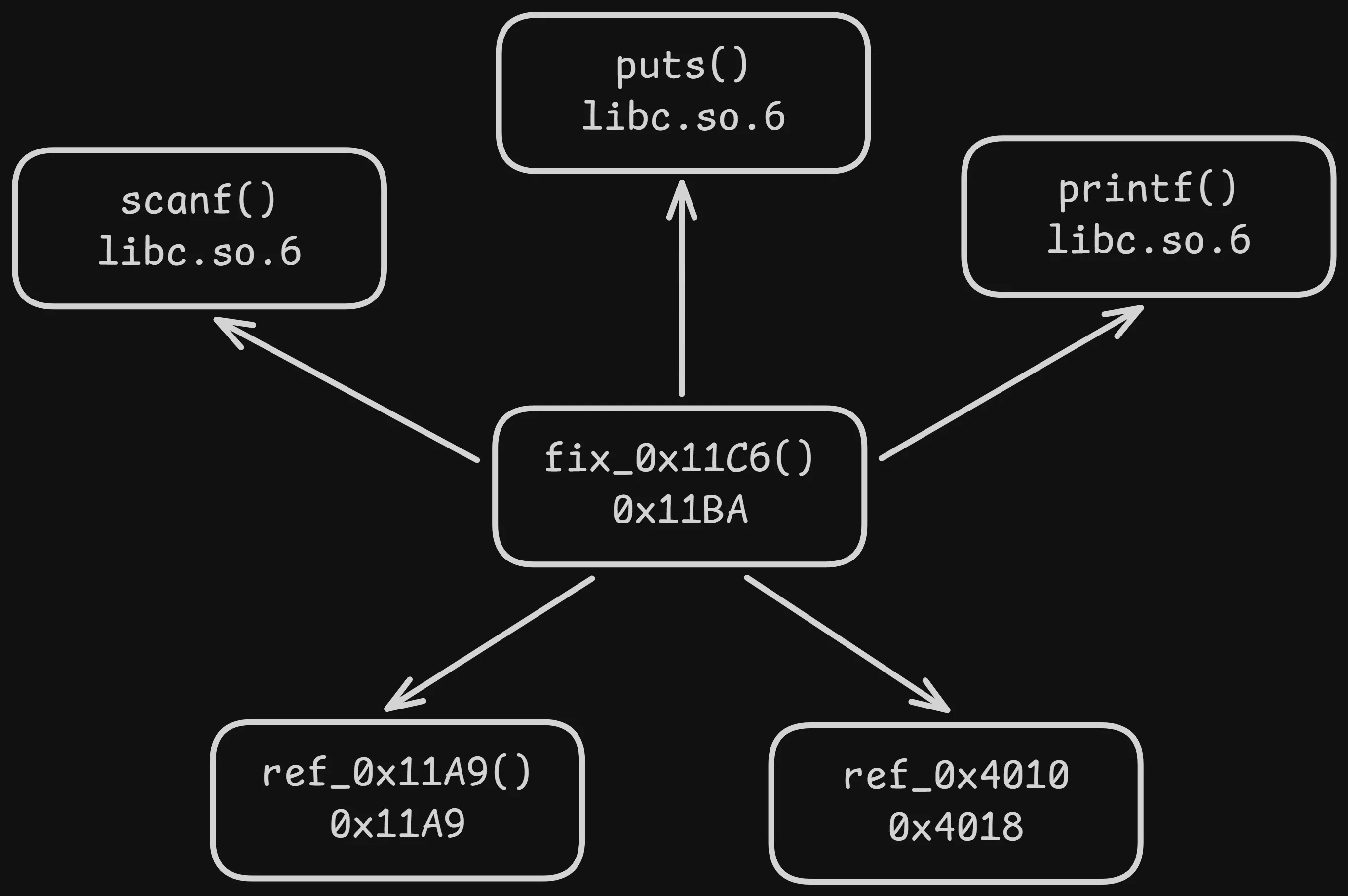
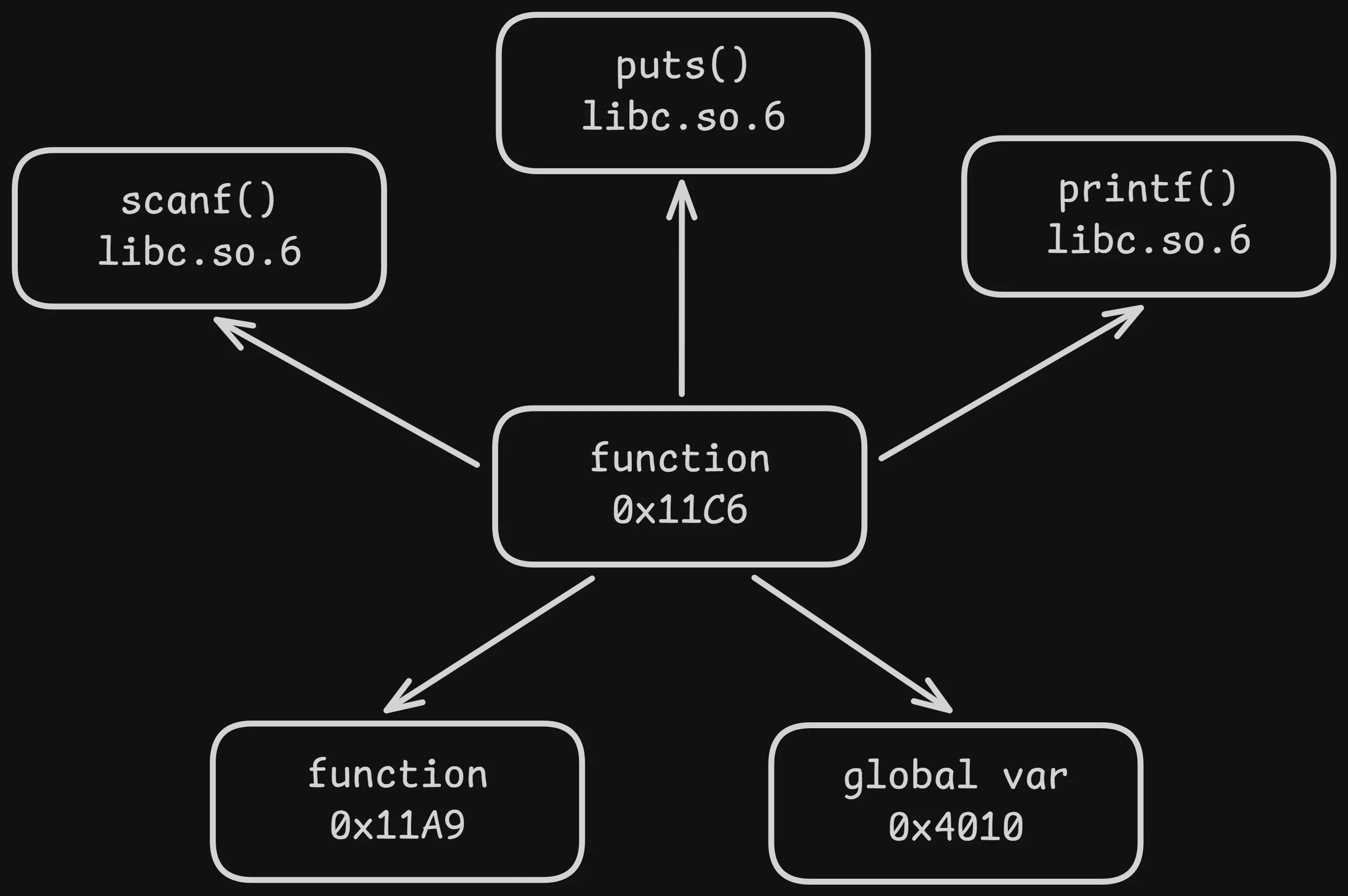
The diagrams illustrate simplified reference graphs of the compiled code from the C patch and the target binary, respectively (yes, dynamically linked functions/methods are also strongly supported by the tool).
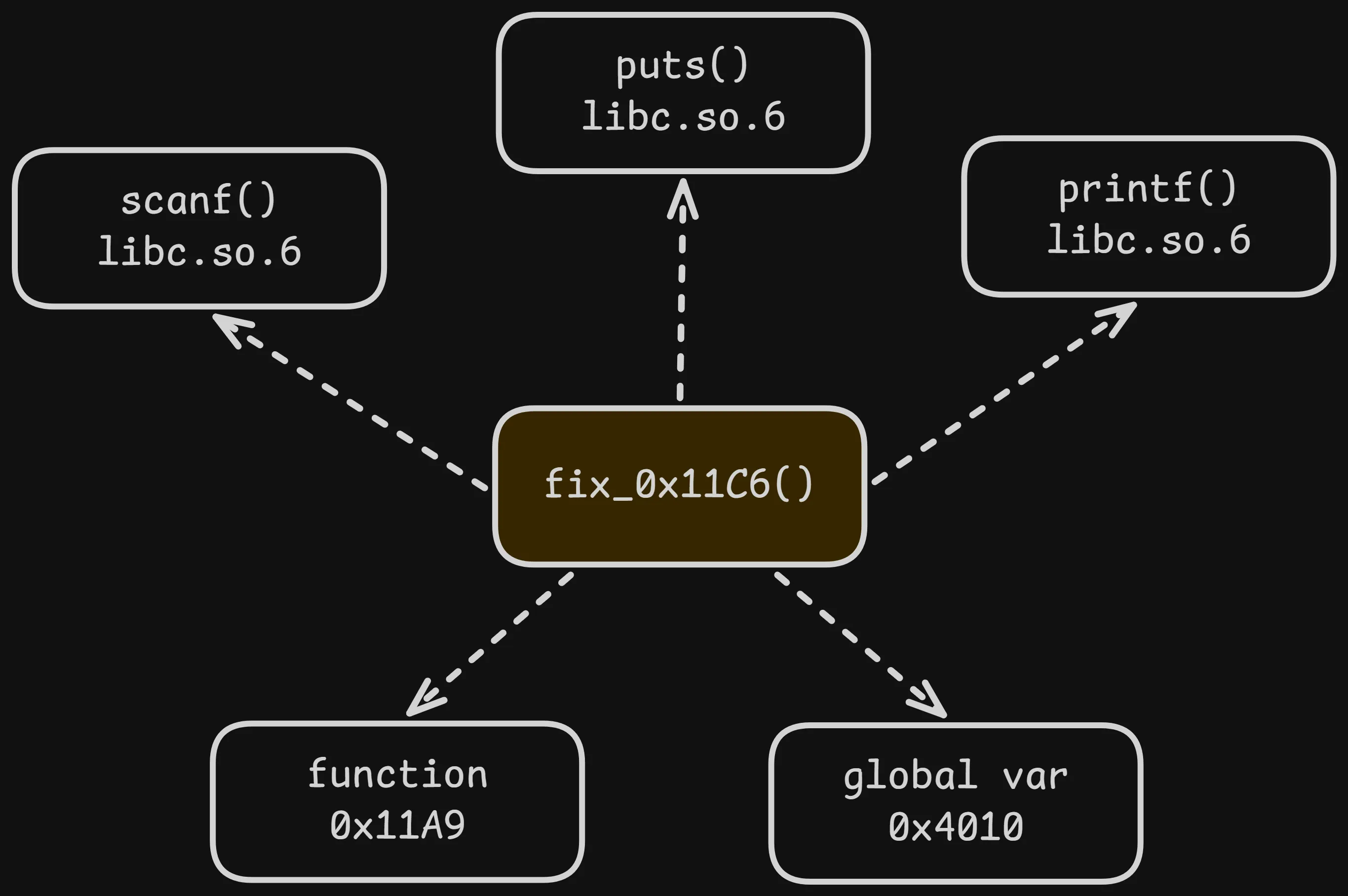
In the final reference graph of the patched binary, the yellow node represents the new component (new main() definition) that was replaced from the patch binary. The dashed arrow lines indicate the references that were patched during the integration process, connecting the newly merged components with the existing symbols in the target binary.
Installation
Install dependencies
These instructions target Ubuntu x86-64, including WSL. The build requires CMake 3.24 or newer.
sudo apt update
sudo apt install -y build-essential cmake git binutils libdwarf-dev libelf-dev zlib1g-dev
cmake --versionThe project also needs the LIEF C++ SDK. Install LIEF 1.0.0 into your user directory:
mkdir -p "$HOME/src"
git clone --depth 1 --branch 1.0.0 \
https://github.com/lief-project/LIEF.git "$HOME/src/LIEF"
cmake -S "$HOME/src/LIEF" -B "$HOME/src/LIEF/build" \
-DCMAKE_BUILD_TYPE=Release \
-DLIEF_PYTHON_API=OFF \
-DLIEF_EXAMPLES=OFF \
-DLIEF_TESTS=OFF \
-DCMAKE_INSTALL_PREFIX="$HOME/.local"
cmake --build "$HOME/src/LIEF/build" --target install -j2Capstone and Keystone are installed and built automatically during the project build.
Build and test
git clone https://github.com/FazeCT/1-patch.git
cd 1-patch
cmake -S . -B build \
-DCMAKE_BUILD_TYPE=Release \
-DCMAKE_PREFIX_PATH="$HOME/.local"
cmake --build build -j"$(nproc)"
ctest --test-dir build --output-on-failureThe first project build needs access to GitHub to fetch Capstone and Keystone.
If CMake cannot find LIEF, locate LIEFConfig.cmake with:
find "$HOME/.local" -name LIEFConfig.cmakeand pass its containing directory as -DLIEF_DIR=<dir_here>.
Documentation
Usage
./1-patch -p PATCH_CODE -i TARGET_BINARY -o OUTPUT_BINARY [OPTIONS]In which, PATCH_CODE is the path to the C patch, while TARGET_BINARY is the path to the binary that should be patched and OUTPUT_BINARY (optional) is the path to the output binary.
-h/--help and -v/--verbose are also available.
Patch syntax
Three prefixes are introduced to write patches: add_, ref_ and fix_.
int add_var1 = 1;
volatile int add_var2 = 2;
void ref_0x12A1 () {};
volatile int fix_0x11C6 () {
ref_0x12A1 ();
return add_var1;
};add_ (usage: add_[identifier]) is used in case a new global variable or a function needs to be added to the binary.
ref_ (usage: ref_[virtual address]_[identifier]) is used when an existing global variable or a function in the binary needs to be reused in the patch code.
fix_ (usage: fix_[virtual address]_[identifier]) is used for completely replacing a global variable or a function with the new definition.
volatile keyword must be used in case a global variable or a function is added but never used in the patch code to avoid compiler optimization. This is usually used for declaring elements with add_ or fix_ prefixes.
For more details, patch examples can be accessed here.
External methods
In case a dynamically linked method needs to be invoked in the patch (for example, printf()), there are two options:
- Include the corresponding library and use the method.
#include <stdio.h>
int fix_0x11C6 () {
printf("hello, world!\n");
};- Declare the method with
ref_and their virtual address in the target binary, and use the method. This only works when the method is already imported in the binary (obviously).
int ref_0x5FEC0_printf(const char *format, ...) {};
int fix_0x11C6 () {
ref_0x5FEC0_printf("hello, world!\n");
};Structs and enumerations
Refer to this example for patching objdump for more information.
Licenses
This work is protected under MIT License.
Extra Information
This work was my Computer Science Bachelor’s thesis in Ho Chi Minh City University of Technology (late 2024).
This work was based on CRISPR by Filippo Cremonese @ Politecnico di Milano and Redback by Quynh Nguyen Anh @ Blackhat Asia 2020.